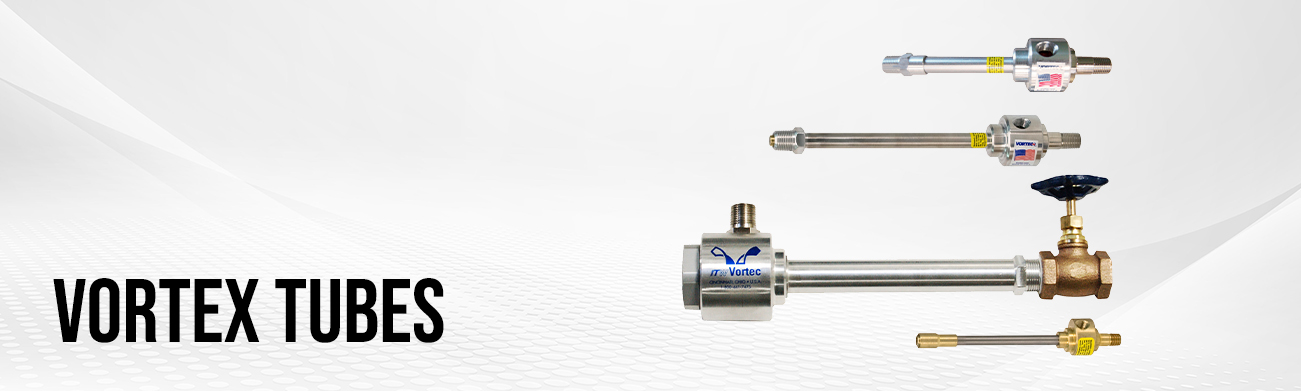
Vortex tubes produce up to 6000 BTU/hr (1757 watts) of refrigeration and temperatures as low as -40
deg to solve a variety of industrial spot cooling and process cooling needs. With no moving parts, a
vortex tube is highly reliable and inexpensive; and requires no electrical connection at the cooling
site. Vortex tubes cool instantly, relying on compressed air spinning in the tube to separate the
air into cold and hot air streams.
Vortex tubes are a compact source of refrigeration and cooling, with models
ranging from 6 – 13 inches (150 – 330 mm) long and cooling capacities ranging from 100 – 6000
BTU/hour (29 – 1757 watts). Vortex tube performance is easily adjustable by changing the inlet air
pressure, ratio of cool air to exhaust or by changing the generator in the tube itself. And while
normally used for cooling, vortex tubes can also be used for heating applications, merely by
channeling the exhaust hot air to the application..
Vortex tube technology was invented by French physicist Georges Ranque in 1930, and first developed
for industrial use by Vortec in the 1960s. See how it works. Since then, vortex tubes have been
applied for a wide range of cooling applications on machines, assembly lines, in processes and for
testing and measurements.
Benefits
Cools instantaneously
Lowest cost per unit of refrigeration of any cooling technique
Fully adjustable cooling, easily moved from site to site as needed
Fits to provide cooling in the most confined areas
Lowest maintenance requirements of any refrigeration technique
Environmentally friendly, with no refrigerants or chemicals needed
Easy to install, just connect compressed air and go
Features
Maintenance free, with no moving parts
Cycle capability within +/- 1 deg
Drops compressed air inlet temperature by up to 100 deg F (55 deg C)
No electricity required at the cooling site
Cools without refrigerants, as low as -40 deg
Compact and lightweight, highly transportable
Adjustable for varying cooling needs
Available heating capacity using the same tube, up to 200 deg F (93 deg C)
Available in both aluminum (208 and 308) and stainless steel (208SS) models
Replacement generators available for modification of cooling or upon contamination
Vortex Tube Specifications
SPECIFICATION
Cooling Capacity (BTU/hr)
Air Consumption @ 100 psig (scfm)
Inlet Size (inch)
Inlet (Female or Male)
Material of Construction
106-2-H
100
2
1/8" NPT
F
Brass / Stainless Steel
106-4-H
200
4
1/8" NPT
F
Brass / Stainless Steel
106-8-H
400
8
1/8" NPT
F
Brass / Stainless Steel
208-11-H
640
11
1/4" NPT
F
Aluminum
208-15-H
900
15
1/4" NPT
F
Aluminum
208-25-H
1500
25
1/4" NPT
F
Aluminum
208-11-HSS
640
11
1/4" NPT
M
Stainless Steel
208-15-HSS
900
15
1/4" NPT
M
Stainless Steel
208-25-HSS
1500
25
1/4" NPT
M
Stainless Steel
308-35-H
2650
35
1/4" NPT
F
Aluminum
328-100-H
6000
100
1/2" NPT
M
Aluminum / Brass
Product Instructions
Case Studies
Adjustable Vortex Tubes Set Manufacturer Up For Success
Company Overview
Dyplast Products is a is a leading manufacturer of polyisocyanurate and expanded polystyrene
products. This includes innovative and cost saving pipe, sheet and block rigid foam insulation for
applications in temperatures up to 350°F (177°C). Their products are available in densities ranging
from 2 to 6 lbs. per cubic foot and have thermal efficiencies that are greater than most of their
competitor’s foam core products. These foam insulations are available in a variety of shapes and
sizes and are used in a large range of industries around the globe.
The Problem
The maintenance and safety manager at Dyplast Products contacted one of our Vortec applications
engineers to explore cooling solutions available to chill sections of a steel conveyor on a
process line. Each section of the conveyor is made of 12 gauge. steel plates. The plates are
individually 64.5” long and 6” wide and weigh14lbs. Over a period of six hours, the temperature
on the steel plates slowly rises from ambient temperature to 115-130°F (depending on the
exothermic chemical process that occurs during transport on the conveyor). The internal
temperature of the polyisocyanurate process called “bunstock” reaches 300°F. This heat was
transferring into the steel conveyor surface. The maintenance manager needed to keep a 24” wide
section in the center of the conveyor (where the bunstock is positioned) at 86°F or less for the
process to remain viable, and to maintain the specifications and quality of the product. In the
past this had not been an issue but changes in the ambient temperature and changes in the
chemical process are causing new problems.
Cadillac of South Charlotte is a stand-alone Cadillac dealer
with a 9,300-square foot collision center. They have two paint booths, which keep Nutter and his
two assistants plenty busy with prep, painting, and moving cars along to the curing oven. For
the past four summers, Nutter has worn a 3M Versaflo face shield that supplies fresh air,
keeping his face and head from overheating.Bruce Dunehew, the Collision Center Manager, was impressed by
the effectiveness of the mask and wanted to expand protection to cool the whole body.“I was excited to see that Vortec offers a cooling vest!”
-Dunehew
The Solution
When other processes such as forced air ventilation, and heat extraction failed, Dyplast
Products looked at vortex tubes. The company liked the idea of cooling steel plates using vortex tubes because it gave them the flexibility to easily move cooling from one section of the plant
to another, based on the conveyors changing needs. The Vortec application engineers calculated
that 8100 btuh of cooling would be needed to keep the 24” center sections of the plates at 86°F
or lower. They suggested using a model 328-100-H and a 328-50-H vortex tube to produce 98 cfm of
air at 0 to 10°F. The recommendation was to blow the cold air through an insulated manifold with
25 orifices to evenly distribute the air over the 24” wide section. The application engineer
also created a sketch and a description to show how to construct the manifold and how to pipe
and filter the compressed air supply to the two vortex tubes. The customer had concerns about
the safety of the hot exhaust air from the vortex tubes, so the application engineer suggested a
way to vent the hot air exhaust without affecting the performance. Another concern about
over-cooling the steel plates arose which would potentially cause condensation. This problem was
simple to solve, as the vortex tube’s cooling capacity can easily be controlled by regulating
the inlet compressed air pressure to the vortex tube (with a pressure regulator).
The Result
The maintenance manager purchased the 328-100-H and 328-50-H vortex tubes and a model 701S-40A150 scfm 5 micron compressed air filter and quickly installed them. The vortex tube solution worked so well that three months later the company ordered two more of each product for
additional processing lines.
Want to learn more about the Vortex Tube? Check out our Vortex Tube Short Course to learn how
the cooling phenomena works!
Protecting Robots In Extreme Environments
Company Overview
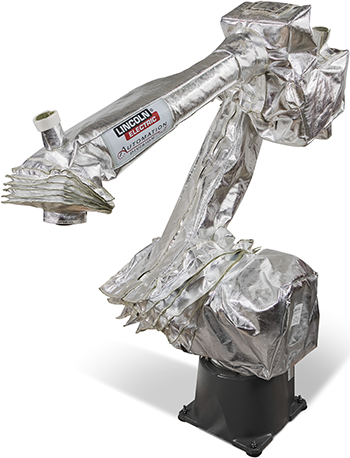
In 1994, after a career of more than 20 years as an engineer designing products for major corporations in the field of robotics and automation, Charlie Tur identified a pressing yet unmet need among companies using robots. Tur decided to found a new company to fill that niche—creating suits to protect robots. More than a decade later, Tur’s company, Roboworld, has offices in both Ohio and Wisconsin and provides custom-built Robo suits to shield robotic equipment in extreme manufacturing environments. Roboworld’s worldwide manufacturing clients, such as Motoman, FANUC, and Lincoln Electric, benefit from well-designed robot “clothing” which protects their automation investments while increasing uptime.
The Challenge
Roboworld Vice President for Design, Sales and Support Mike Tur explains “robots typically are placed in environments where you don’t want to put people—very hot or extremely cold environments, for example. The robots may also do highly repetitive tasks or handle work most human labor would find too unpleasant or unsafe to perform. This means these robots are subject to conditions which could potentially cause damage. Our suits protect them from such hazards...one of which is high temperature environments. However,in those high temperature environments, if you install a protective suit on an electrically-driven device (robot), the heat level can rise even higher than the ambient temperature. ” Thus the need for some method of cooling the robot suits is especially strong in these high heat environments.
The Solution
Tur realized from the start that the company’s Robo suits required a cooling unit. Initially, the firm contracted with several air cooling equipment suppliers, including Vortec, for cooling tubes installed inside the suits. Over time, Tur notes, Vortec distinguished itself from the competition through “better pricing, prompt delivery of products as well as ease of operation —customers can quickly grasp the vortex tube concept and how it works.” He observes that “for years now, we’ve only used Vortec. There’s no reason to use another supplier.” Roboworld uses Vortec’s 308 and 328 series vortex tubes for their cooling applications.
The Conclusion
OVACO has been using Vortec products for four years. The company’s relationship with Vortec may
expand in the future, Ireland says. “Given how successful our use of their products has been, I
can see ordering more of what Vortec offers. I know they make several types of vests and we may
order those at some point.” Ohio Valley Aluminum’s Corporate Safety Manager says that she has
already informed other businesses of the excellence of Vortec’s products: “One of our
contractors was visiting our site and I gave him one of the vests to wear and let him know who
made it. I definitely recommend Vortec. They are excellent to work with.”
How Roboworld Benefits From Vortec Products
Tur characterizes Vortec’s cooling tubes an affordable, effective solution while providing a high level of reliability. “We create a high quality product for our customers and we need cooling devices which stack up,” he states. He also notes that Roboworld has expanded its use of Vortec cooling products: “We now use them not just to cool the suits for robots themselves,but also to provide cooling in the covers we make for robot controllers.”
The Conclusion
Mike Tur observes that “We have a good relationship with Vortec because of the consistency and quality of their products and their service.” Thanks to his company’s positive experience with Vortec, Tur has referred clients seeking industrial cooling solutions to Vortec.