192/3 United Industrial Compound, Pokharan Road No. 2, Thane - 400610.

Unique solutions for your unique application

Versatile Spot Cooling for Machining, Repair Shops and More

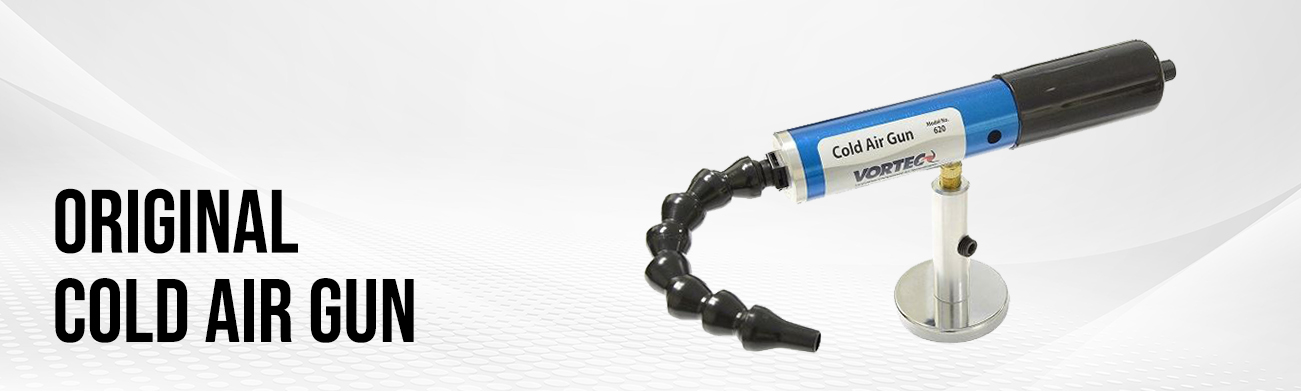
Cold Air Guns use vortex tube technology and filtered compressed air to produce sub-freezing air as low as -30 deg F (-34 deg C) for numerous industrial spot cooling applications. With no moving parts to wear out, Cold Air Guns require no electricity, just a compressed air source. The air consumption range is from 15 SCFM to 35 SCFM.

Cold Air Guns are most often used for cooling of metal parts, in the machining and repair of metals, plastics, wood, ceramics and other materials. Cold air machining outperforms mist coolants and substantially increases tool life and feed rates on dry machining operations. The effective cooling from a cooling gun can eliminate heat-related parts growth while improving parts tolerance and surface finish quality. Cold Air Guns have adjustable temperature and flow settings; and some models have a frost free nozzle to eliminate mess from frost and condensation.

Cold Air Guns are most often used for cooling of metal parts, in the machining and repair of metals, plastics, wood, ceramics and other materials. Cold air machining outperforms mist coolants and substantially increase tool life and feed rates on dry machining operations. The effective cooling from a Cold Air Gun can eliminate heat-related parts growth while improving parts tolerance and surface finish quality. Cold Air Guns have adjustable temperature and flow settings; and some models have a frost free nozzle to eliminate mess from frost and condensation. The air consumption range is from 15 SCFM to 35 SCFM.

Benefits

  1. Increase dry machining speeds up to 36%
  2. Extend tool life by 50%
  3. Eliminates the mess, expense and safety concerns of using mist coolants
  4. Reduce waiting or normalization time by cooling parts faster
  5. Eliminate the potential for burning and scorching
  6. Avoid secondary parts cleaning after machining
  7. Reduce grinding wheel loading caused by overheating
  8. Airflow clears sawdust, shavings and dirt away from surface

Features

  1. Creates cold air up to 100 F deg (+ 56 C deg) below the inlet compressed air temperature
  2. Quiet operation; meets OSHA noise specifications
  3. Adjustable temperature and flow rate
  4. Highly reliable with no moving parts
  5. Low pressure outlet air
  6. Uses only compressed air – no Freon
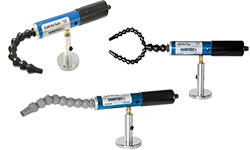
  7. System includes a magnetic base and a 5 micron auto-drain compressed air filter
  8. Magnetic base allows for easy, close in positioning and easy portability

Original Cold Air Gun Specifications

SPECIFICATION 611 611-1 621 621-1 631 631-1
Cooling Capacity (BTU/hr) 900 900 1500 1500 2500 2500
Minimum Outlet Temperature (deg F) -10 -10 20 20 35 35
Compressed Air Pressure (psig) 80 - 100 80 - 100 80 - 100 80 - 100 80 - 100 80 - 100
Air Consumption @ 100 psig (scfm) 15 15 25 25 35 35
Inlet Size 1/4" NPT 1/4" NPT 1/4" NPT 1/4" NPT 1/4" NPT 1/4" NPT
Outlet Air Flow Rate (scfm) 2 - 15 2 - 15 7 - 25 7 - 25 16 - 35 16 - 35
Recommended Filter Size 25 scfm 25 scfm 25 scfm 25 scfm 35 scfm 35 scfm
Recommended Filter 7015-24A 7015-24A 7015-24A 7015-24A 7015-24A 7015-24A
System or Gun Only? System Gun Only System Gun Only System Gun Only
Dimensions (inches)
Overall Length 19 5/8 19 5/8 19 5/8 19 5/8 19 5/8 19 5/8
Diameter 1 3/4 1 3/4 1 3/4 1 3/4 1 3/4 1 3/4
Nozzle Length 9 9 9 9 9 9
Flexible Nozzles Diameter 1 3/16 1 3/16 1 3/16 1 3/16 1 3/16 1 3/16
Outlet Diameter (ID) 3/8 3/8 3/8 3/8 3/8 3/8
Magnetic Base Height 4 1/8 - 4 1/8 - 4 1/8 -
Weight (lbs) 3.0 1.0 3.0 1.0 3.0 1.0
Supply Hose
Diameter (inches) 3/8 3/8 3/8 3/8 1/2 1/2
Maximum Recommended Distance (feet) 25 25 15 15 30 30

Product Instructions


Case Studies

Cold Air Enhances Dry Grinding
Company Overview Storr Tractor Company is a commercial equipment distributor that has been serving the turf industry since 1945. With branches in New Jersey and New York, they offer a full line of Toro turf equipment and irrigation systems, as well as many other allied products. They have been recognized numerous times for their contributions to the turf industry and are committed to providing their customers with the highest quality products and services. Some of Storr’s customers include major New York sports teams including the Yankees, the Mets, and the Giants as well as golf courses that host major PGA and US Open events.

The Challenge Storr Tractor Co is a distributor for the Bernhard Reel and Bedknife grinders, which are used for precision sharpening of reel type mowers, commonly found at high profile golf courses and major league sports stadiums. Storr also provides professional sharpening service for many customers who are without grinders. Many customers routinely sharpen their reels every few weeks to ensure perfectly manicured greens, tees, and fairways. Bernhard, Foley, and many other manufacturers typically use a water-based coolant system on their machines to keep the workpiece cool during sharpening. Over time using the coolant system, many grinders will start showing signs of surface rust. This, mixed with the mess created by liquid coolant, is what prompted Storr to look for a new cooling method.

The Solution Andy Berenty, the Commercial Customer Support Manager at Storr Tractor, was familiar with one of Vortec’s older products that was used to cool and heat automobile carburetor chokes (aptly named Choke Tester). He recalled that Vortec also made a product that was used to cool cutting tools and workpieces in dry machining applications. Andy contacted Vortec and explained the blade grinding application to one of their application engineers. After reviewing Storr Tractors’ needs together, Andy and the application engineer determined that the 610-1 Cold Air Gun was the best and most economical choice for the application. The 610-1 produces cold air temperatures as low as -10°F (-23°C) and up to 900 btuh of cooling using just 15 scfm (425 slpm) of filtered compressed air. In the application, the Cold Air Gun keeps the mower blades cool during grinding, so they do not expand from the heat to create uneven blade edges.

The Result The shift to dry grinding with the Vortec Cold Air Gun was a welcomed change for Storr Tractor. It helped them cool vital grinding tools while preventing the rust and mess typically seen with liquid coolants. Over the past few years, Toro has enhanced the material of the cutting components to create longevity and edge retention of the blades that are used in their cutting units. Sharpening this new metal without overheating and creating distortion is key. The labor for maintaining reel type mowers is a huge investment that directly relates to aesthetics, playability, and more importantly, maintaining turf health to minimize water usage as well as expensive chemicals that control a variety of turf diseases. Over the last two years, they have purchased many units to utilize on their in-house machines, along with adding the Vortec 610-1 Cold Air Guns as an optional feature on all the grinding equipment that is used for reel sharpening equipment in our industry.

Workwear Production Output Improved by Cold Air Guns
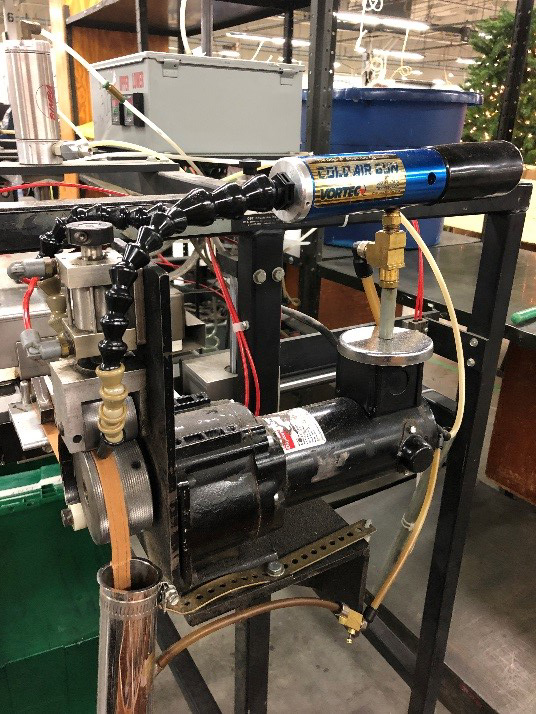
Company Overview Recently we had the opportunity to work with a well-known manufacturer of men’s and women’s clothing, boots, and accessories, famous for their high quality, rugged workwear. The manufacturer was using one of our older Cold Air Guns to cool the double needle in a banding machine that was sewing Cordura fabric. The Cold Air Gun keeps the needles cool, preventing the looper thread from burning in two.

The Challenge The same manufactured noticed another fabric-related problem where a Cold Air Gun would be a beneficial solution. When fabric to make a belt loop comes off the fusing machine, it needs to be cooled before moving to the next stage of production. To finish the process, the material for the belt loop is folded over narrow adhesive tape and sewn together. The material is then sewn into long 250-300 ft. strips, after which the material enters a heater for approximately 60 seconds. As the material is heated, it fuses to stiffen and strengthen. When the fused belt loop exits the heater, it’s nearly 150°F and has to cool before moving to the next stage of production.

The Solution The manufacturer decided to try the Cold Air Gun that was already in use on their banding machine to see how it would work in the belt loop fusing process. When the process worked, the manufacturers’ engineers contacted Vortec to determine which Cold Air Gun model they were already using. By looking at the color of the generator, the Vortec application engineer concluded that the manufacturer had a model 620, 25 scfm Cold Air Gun. To make the Cold Air Gun fit the application better, Vortec Engineers suggested utilizing the flexible dual nozzle to split the cold air stream to cool the material before and after the wheel that compresses the heated material together.

The Result After purchasing and installing the model 622 Cold Air Gun, the manufacturer was able to cool the belt loop material from 150°F to 85°F, which allowed the fabric to be immediately spooled without damage to the material or wait time between the processes. If you’re curious about which Cold Air Gun model you have, or what generator is inside your Vortex Tube, watch our video on locating and changing your generators

The cold air gun operates on the vortex tube principle. High pressure (compressed) air enters the inlet and flows into the annular space surrounding the generator. As it flows through the generator nozzles, the air loses some of its pressure, expands and begins to spin in the generator where it gains near sonic velocity. The nozzles are oriented so that the air is injected tangentially to the circumference of the generation chamber. All the air leaves the generation chamber and goes into the hot tube. Centrifugal force keeps the air near the inside wall of the hot tube as it moves toward the valve at the hot end. At the end of the hot tube is a valve that is adjusted to allow only a portion of the air to escape through a hot air muffler. The remaining air is forced to the center of the hot tube, creating a counter-current flow where, still spinning, circulates back to the cold outlet. The air travels the entire length of the hot tube, through the center of the vortex generation chamber and then through a cold air muffler and to the cold outlet, where chilled air is directed through the flexible Locline nozzle.

Discover How Cold Air Guns Use Argon Gas in Aerospace Application
Customer Overview An aerospace parts manufacturer, for a major player in the aerospace industry, fabricates and welds stainless-steel and Inconel to produce a variety of parts for the airframes and engines used on commercial jets. The aerospace manufacturer was having difficulty producing acceptable prototype parts for a project that they were bidding on. If they could not produce a quality prototype in time, they were going to lose the bid and potentially hundreds of thousands of dollars.

The Challenge This particular stainless-steel part was being TIG welded using argon for the shielding gas. The shielding gas was used not only for the weld gun but also supplied to a fixture to 'bathe' the internal sections of the part in the inert gas. This was meant to keep the back side of the weld clean and free of carbon. During the welding operation, the thin stainless-steel was warping slightly, causing some dimensions to go out of tolerance.

The warping of the stainless-steel part was due to the heat input and welding speed not being kept within the appropriate parameters (this may vary depending on the type and size of the part). Any attempts to speed up this process can cause distortion and warping. The only way to truly avoid warping is to apply slow, cool air onto the product. This is where we came in.

The Solution The aerospace manufacturer, who had prior experience with Vortec's enclosure cooling products, wanted to see if the shielding gas to the fixture could be cooled via a Vortec Cold Air Gun. This cooler welding gas would help to counteract the heat created by the welding. The aerospace manufacturer reached out to us and spoke with one of the application engineers describing the problem. The Vortec application engineer understood the issue and configured a model 610 Cold Air Gun, with the appropriate inlet and outlet connections, that would match up with the customer's attachments on the argon supply and the fixture connection.

After a test run, the Vortec application engineer found that the connection on the fixture was undersized, therefore it was restricting the cooling capabilities. The Vortec application engineer recommended that the fitting size on the fixture be increased from ¼" tubing to a ½" tubing to reduce the backpressure on the Cold Air Gun. This change allowed the Cold Air Gun to operate more effectively and produce the cooling capacity needed to successfully keep the part cool and the dimensions within tolerance.

As an added safety measure, the Vortec application engineer recommended that the aerospace manufacturer also use a model 903 Air Flow Amplifier to duct and expel the argon gas and welding fumes away from the welder. This was to ensure the welder's safety and maintain a well-ventilated area.

The Results By implementing the simple change of adding a Cold Air Gun to their welding process, the aerospace manufacturer not only improved the quality of their process but won the bid on the project. As an added bonus, they were cheaply able to improve the safety of their welders by implementing an air amp to duct fumes. The manufacturer is now looking into how they can bring Cold Air Guns into other areas of their facility and make additional process improvements.

The cold air gun operates on the vortex tube principle. High pressure (compressed) air enters the inlet and flows into the annular space surrounding the generator. As it flows through the generator nozzles, the air loses some of its pressure, expands and begins to spin in the generator where it gains near sonic velocity. The nozzles are oriented so that the air is injected tangentially to the circumference of the generation chamber. All the air leaves the generation chamber and goes into the hot tube. Centrifugal force keeps the air near the inside wall of the hot tube as it moves toward the valve at the hot end. At the end of the hot tube is a valve that is adjusted to allow only a portion of the air to escape through a hot air muffler. The remaining air is forced to the center of the hot tube, creating a counter-current flow where, still spinning, circulates back to the cold outlet. The air travels the entire length of the hot tube, through the center of the vortex generation chamber and then through a cold air muffler and to the cold outlet, where chilled air is directed through the flexible Locline nozzle.

Wrapping It Up: Vortex Air Gun Aids in Aerospace Applications
Company Overview The global corporation MAG offers a comprehensive line of equipment and technologies serving a wide range of industries including aerospace, automotive and truck, heavy equipment, oil and gas, rail, solar energy, wind turbine production and general machining. Their services include process development, automated assembly, turning, milling, automotive powertrain production, composites processing, maintenance, automation and software development. The company has facilities in the Americas, Asia and Europe. The headquarters for MAG Americas is located in Erlanger, KY and they have five main production facilities in North America, including one located in Hebron, KY, which is the center of excellence for composites technology.

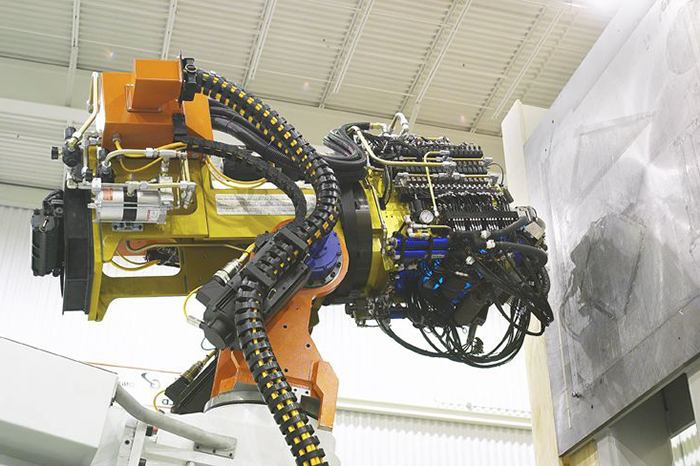
The Challenge Milo Vaniglia is Senior Project Engineer at the Hebron facility where he directs mechanical design of new products. Vaniglia's team developed the company's VIPER® Fiber Placement Systems (FPS). This composite fiber placement machine combines the advantages of tape laying and filament winding with advanced computer control and software. The fiber-reinforced graphite composite parts the VIPER® produces offers significant advantages over metal for the aerospace industry. Essentially, the VIPER® provides an effective method to make graphite/epoxy one-piece structures for aerospace applications.

The VIPER® machines have seven separate axes of motion, making them particularly suited to highly contoured structures such as cowls, ducts, fuselage sections, pressure tanks, nozzle cones, tapered casings, fan blades, spars and "C" channels. In developing this innovative system, Vaniglia realized that a cooling component was essential to prevent the tow or ribbon of composite tape from adhering to itself prior to placement, thus guaranteeing wrinkle-free, near net shape lay-up. In providing its high-profile aerospace customers with this technology, MAG demands excellence of all the components used in the VIPER® FPS. Vaniglia needed an air products company capable of meeting this challenge.

The Solution Vaniglia chose Vortec because he was confident the company possessed the engineering expertise to meet the VIPER®'s need for cool air delivery. Vortec's Cold Air Gun 610 converts compressed air into chilled air which conditions the pre-impregnated graphite fiber resin, resulting in the highest possible dexterity, flexibility and range for large to complex aerospace parts. "Vortec's product makes it easier to dispense the pre-impregnated raw material," Vaniglia notes.

How MAG Benefits from Vortec Products "I have found Vortec to be very responsive to our needs," Vaniglia observes. "They offer a product which is both consistent and versatile." He notes that because the Vortec Cold Air Gun is so effective, MAG not only uses the product in all of the different models of VIPER® systems, but it has also increased the volume of Vortec products in each of these systems, using Cold Air Guns to cool other parts of the machine.

Conclusion "We provide our clients with a high-quality machine," Vaniglia states. "Vortec contributes a product which helps make our system excellent." The Senior Project Engineer, who has been using Vortec products since 1988, says he has found Vortec "very easy to work with. I would definitely recommend them."

Cooling Large Industrial Parts in 60 Seconds

This was the challenge faced by Anderson Machine Manufacturing, a Richmond, VA-based company which builds custom machines for a broad spectrum of industries and applications. In 2009, one of their clients, a multi national corporation, sought Anderson Machine’s aid in creating a machine to compress and cool the components of an industrial-size gear box shaft. The client wanted extremely rapid cooling, so top of the line air equipment was a necessity. Since the components of the machine had to remain dry, mist cooling was not an option. Todd Anderson, Vice President and Mechanical Engineer at Anderson Machine, explains that “as a mechanical engineer, you know to do what you’re good at and find the best experts you can for other areas. We knew that in this case, meeting the client’s requirements meant finding an extremely high level of expertise in air technology.” After learning about Vortec online, Anderson explained the machine his client sought. Vortec engineers analyzed the specifications Anderson provided and developed a solution. “Building as many different machines as we do, I deal with a lot of different vendors,” Anderson states. “With Vortec, they hit the ground running, grasping our needs right away instead of needing to have things explained to them twice. We told them how big the assembly was, what materials were involved and the timeframe. They performed the heat load calculations to determine which products would work, then sent a spreadsheet showing the products with the right cooling capacity.” By using four of Vortec’s model 610 Cold Air Guns, Anderson was able to deliver a machine which cooled the equipment quickly, meeting the client’s requirements. Vortec’s engineers realized that, although the Cold Air Guns effectively cooled smaller equipment, a two-stage cooling process was necessary to bring down the temperature of the larger, denser equipment. They suggested that Anderson retrofit the machine, adding a preliminary cooling phase. Vortec also recommended shifting to the larger, more powerful model 630 Cold Air Guns rather than the smaller model 610’s which were originally used. The 2-part cooling cycle necessary for the larger equipment involves using Vortec Curtain Transvector Air Knives to remove most of the heat, taking the temperatures of equipment from 350 to 150 degrees F. The Curtain Transvectors use compressed air, amplifying the air flow to rapidly dissipate heat by bringing more airflow (cubic feet perminute) to bear on the equipment. Curtain Transvector air knives bring more than three times the cooling capacity of standard nozzles. During this initial stage, machine operators can stop the process and take infrared temperature readings. In the second stage of the cooling process, four of Vortec’s Cold Air Guns model 630 cool the equipment, lowering the temperatures from 150 degrees F to under 110 degrees. The combination of the model 630 Cold Air Guns and Model 921 Curtain Transvector air knives bring the temperature of the large gear equipment down from 350 degrees to 100 degrees F in less than a minute. “I give Vortec high marks,” Todd Anderson states. “When we presented them with an increased level of challenge based on our client’s new specs, they didn’t blink. The Vortec crew really has their heads screwed on right as far as interfacing with clients. And in addition to great products and an excellent understanding of technology, they also offer a very reasonable price.”
Automotive Manufacturing: Quality Over Quantity, Why Not Have Both?

TS Trim Industries, manufacturer of interior door panels for Honda Accords, Civics, and CRV’s, produces over 3,400 sets of door panels a day. They have a manufacturer, Sinto located in Japan, that contains 10 automated assembly machines that ultrasonically weld components to the plastic panels. There are a total of 48 weld horns on the ten machines, 8 machines with 4 horns each and 2 machines with 8 horns each, and each machine uses a great deal of pneumatics for transport, clamping and control. The current welding cycle is 32 seconds, they needed to decrease it to 30 seconds or less to increase productivity and the quantity of doors manufactured. However, the faster cycle times cause plastic “stringers” (as seen in the picture to the right) which is a major quality control issue. This welding process is the bottleneck in the door panel process. They needed a quick and permanent solution to ensure both quality and quantity were met. Additionally, the amount of heat required to effectively assemble the interior of the door was causing damage to the weld horns. This was requiring them to order replacements every month, costing them over $50K a month. They needed a quick and affordable solution that would cool the weld horns, to eliminate “stringers” ensuring high quality, and simultaneously cool the weld horns to reduce, or hopefully eliminate, the need for replacements each month. The 4 weld horns on the 8 machines were previously being cooled externally with compressed air, approximately 2 cfm, routed through a 6mm flexible tubing and then though a ¼” x 6” long copper tube. The air from the copper tube was only blowing on one side of the horn. The 8 weld horns on the 2 machines are cooled internally and externally with compressed air. After reviewing their unique application, we recommend a solution that would solve both problems. We recommended that they use our 631, 208, or 106 model cold air guns and vortex tubes to solve the quality and quantity problem. In fact, a sister company of theirs in Canada, currently uses several of our 631’s on their assembly line for a similar application. After demonstrating the 631 and 208-15-H vortex tubes, showing the cold air flows and cold temperatures achievable, they liked the 208 physical size and performance the best. Although the 208-15-H is an excellent fit, the key to solving their problem, and hopefully allowing for further increases in the cycle time, is getting enough compressed air to the vortex tube to properly cool the weld horns effectively. The current 6mm tubing routing will most likely need to be bypassed, or altered, to allow acceptable air flow and pressure. Although the right tool is always important, it’s crucial to look at all aspects of the application and see how continuous improvements can be made.